
Small Business AI Automation: Start With One Bottleneck
Small business AI automation works when you fix one painful bottleneck first — not when you run a transformation programme. Here's how to find yours.

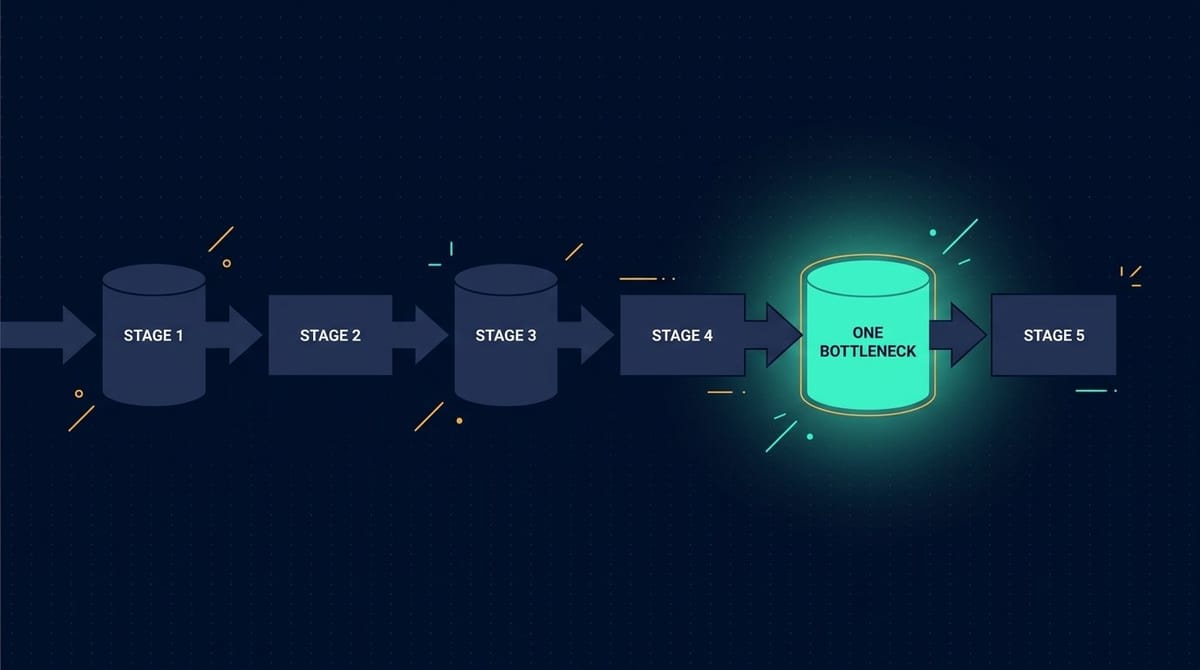
The "digital transformation" pitch has a long and inglorious history. In the 2010s, every SaaS vendor promised to transform your operations. Most small businesses that bought in spent months on implementation, training, and configuration — and ended up with a more complicated version of what they had before. Now the AI vendors are running the same play. The businesses actually winning with small business AI automation aren't running transformation programmes. They're fixing one specific, painful thing and moving on.
By the end of this piece, you'll know exactly how to identify that one thing — and what to do with it.
Why "AI transformation" is the wrong frame for small businesses
The transformation framing isn't just oversold. It's structurally wrong for small businesses.
Boston Consulting Group popularised what they call the 10-20-70 rule for AI implementation: roughly 10% of the work is algorithms, 20% is technology and data, and 70% is people and process change. That last number is the killer. Enterprise companies can throw change management budgets, dedicated project teams, and months of internal communication at that 70%. A five-person agency cannot.
When enterprise AI playbooks get recycled into small business advice — and they always do — that 70% quietly disappears from the conversation. What's left is a list of tools and an implicit assumption that the hard part is choosing them. The hard part isn't choosing them. The hard part is actually changing how your team works, and small businesses simply do not have the slack to absorb that disruption while also running the business.
So transformation stalls, the tools go unused, and the business owner concludes that AI doesn't work for them. It didn't fail because AI is bad. It failed because the frame was wrong from the start.
There's also a useful corrective to the full-automation fantasy buried in discussions from people who've actually been through this. One r/smallbusiness thread put it clearly:
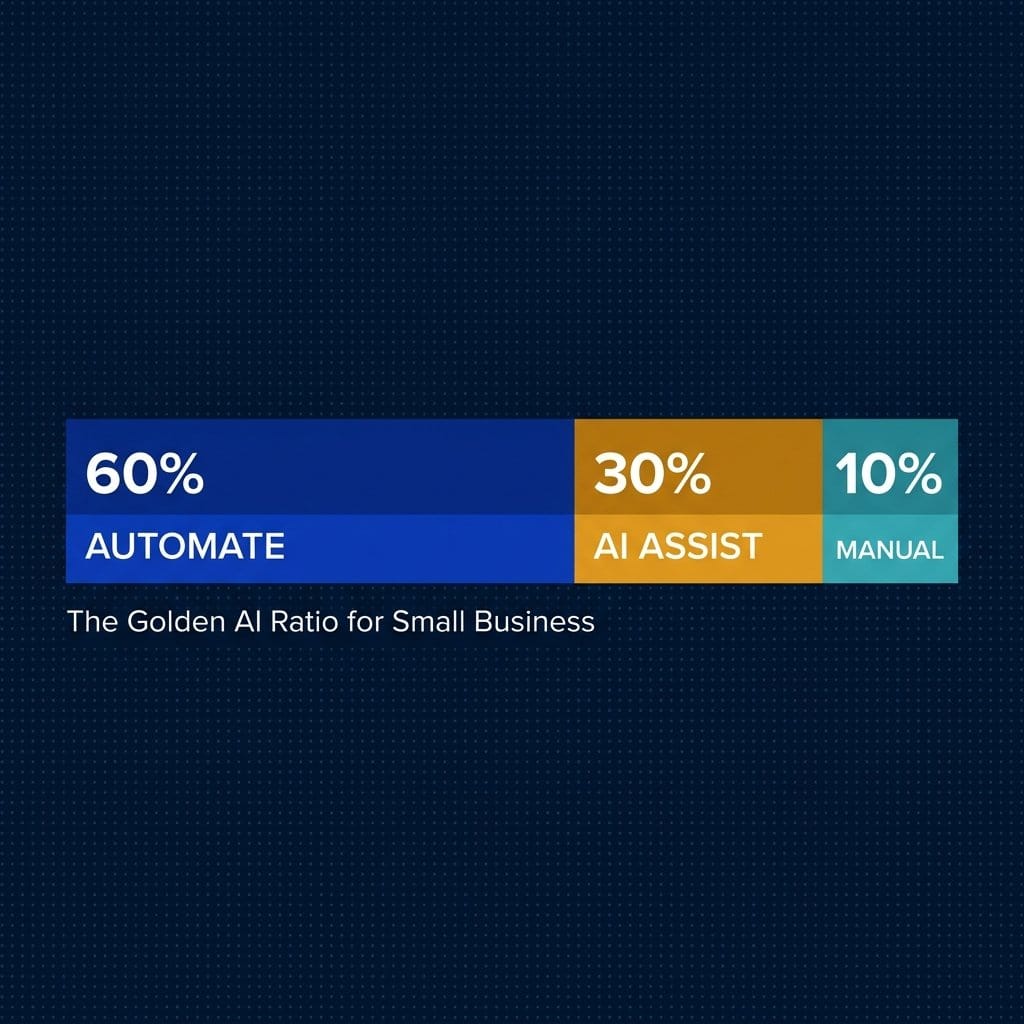
"AI automation was never really about automation, it's about leverage... Automate the first 60% of the process, the boring, repetitive steps. Use AI to assist a human on the next 30% the parts requiring judgment or context. Leave the final 10% manual, because sometimes a human simply does it better."
— r/smallbusiness (link)
The "Golden AI Ratio" framing here is more honest than most vendor copy. Full automation is the exception, not the goal. And for a small business, that matters, because it means your first automation doesn't need to replace a human. It just needs to take one painful slice off their plate.
The bottleneck audit: finding the one thing worth automating
Here's a 30-minute exercise that's more useful than any AI strategy document.
Ask yourself three questions. What task do you or your team dread most each week? What's the one thing that, if it were faster, would unblock everything else downstream? Where do things consistently fall through the cracks — not because people are careless, but because there's too much to track manually?
You're looking for the intersection of "we do this constantly" and "it takes too long and nothing else can happen until it's done." That's your bottleneck.
Real examples from small business owners illustrate this. A water-distribution business, according to discussions on r/smallbusiness, was reportedly receiving 100 to 200 WhatsApp orders every day — entered manually into their system by a single person. The entire operation depended on that one manual step. Another business owner described an AI system that cut their Monday data-consolidation task from hours to minutes. Someone had identified one specific, painful task and targeted it precisely.
Neither needed an AI strategy. They needed one targeted fix.
What makes a good first automation target
Three characteristics mark a strong first automation. It's high-frequency: something you or your team does daily or weekly, not once a quarter. It's rule-based enough that AI can handle it without deep judgment on every step. And it's genuinely painful — something actively limiting your capacity or blocking other work, not just a mild annoyance.
The trap here is worth naming. Most people automate what's easiest to automate, not what actually matters. Social media scheduling gets automated first because it feels obvious and there are clear tools for it. But if social posting isn't your bottleneck — if the real drag is invoice chasing, or client onboarding, or weekly reporting — automating social posts does nothing for your actual capacity. You've spent time on a feel-good automation that doesn't move the needle.
Marketing agency case study: the reporting bottleneck
Imagine a five-person content marketing agency. Every Friday afternoon, two or three hours disappear into the same ritual: pulling data from Google Analytics 4, cross-referencing it with social performance metrics, writing a plain-English summary of what happened this week, and formatting everything into a slide deck for clients.
This is a textbook bottleneck. It blocks client calls before the report is ready. It eats into new business development during prime pitching hours. And it's mind-numbing enough that whoever draws the short straw resents it by hour two. The task is high-frequency, largely rule-based, and genuinely painful.
The fix doesn't require an AI strategy. It requires scoping one workflow: connect Google Analytics 4 to an automation platform like n8n or Make, pull the weekly data on a schedule, pass it to a large language model with a prompt that produces a consistent narrative summary, and output the result to a slide template. The whole build takes a few days of focused work, not months.
Once it's running, Friday afternoons are free. Client relationships improve because reports go out faster and with more consistent framing. New business capacity increases because people have time to pitch. None of that followed from an AI strategy. It followed from fixing one specific, painful thing.
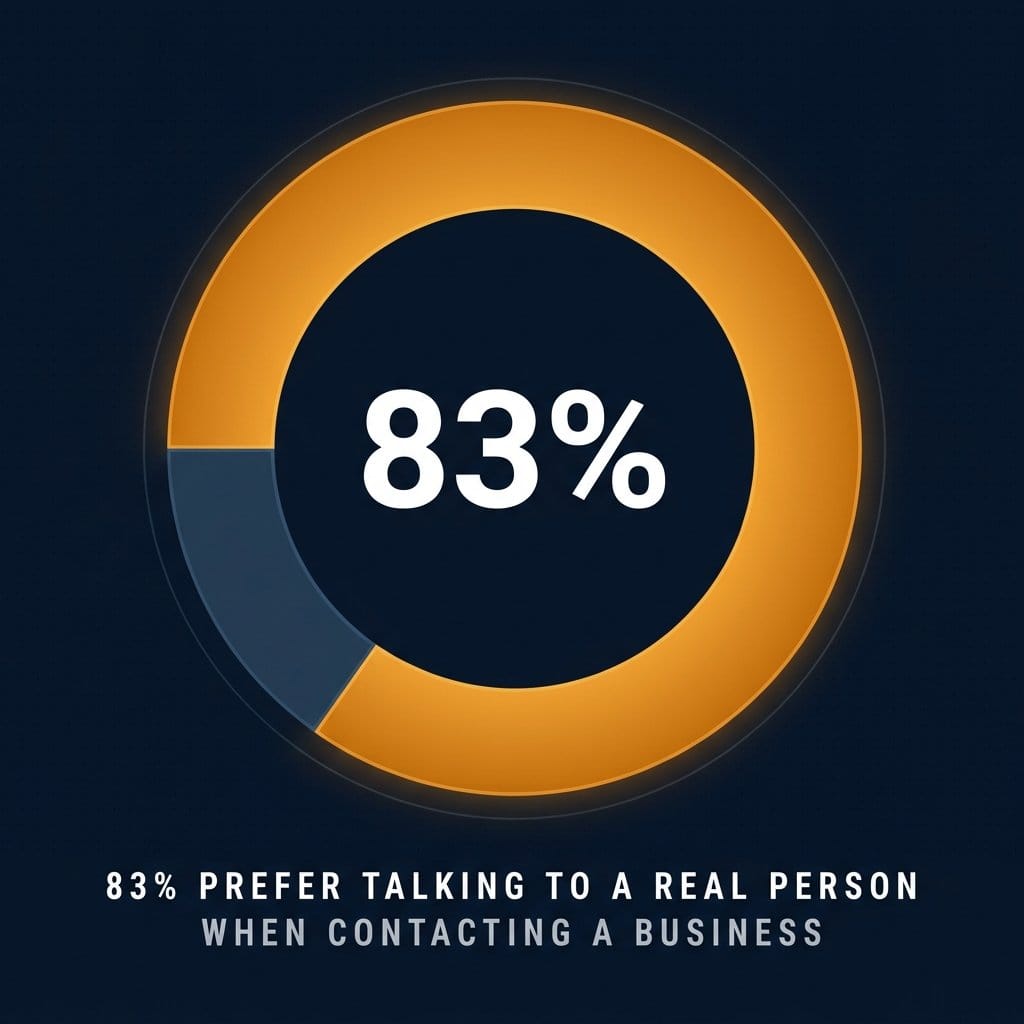
The broader lesson matters here. According to a survey of 6,000 adults by AnswerConnect and OnePoll, 83% of people say they would rather speak to a real person than to an AI when contacting a business. That stat should inform where you point your first automation. Don't automate the customer-facing touchpoints first. Automate the internal work that currently prevents your team from showing up well to those touchpoints.
The trap of automating the wrong thing first
Social media is the most common wrong first target. It's not that automating social content is useless. It's that for most small businesses, social content is not the bottleneck. The reason it gets automated first is that the tools are obvious, the use case is clear, and it feels productive. Scheduling a week of posts in advance has a satisfying completeness to it. But if your actual constraint is that client onboarding takes three weeks because it's all manual emails and chased documents, automating your Twitter queue has bought you nothing.
The complexity trap is equally dangerous. One r/smallbusiness thread got this exactly right:
"I've been testing different AI automations on small business websites over the past months and honestly most of them are overkill... Everything else usually turns into a complicated system that small businesses never maintain."
— r/smallbusiness (link)
The problem with automating five things at once is that complexity scales non-linearly. One workflow breaks because an API changes. Another stops working because someone changed a spreadsheet format. A third was never fully configured. Now you have five broken automations and no one on the team with the capacity to fix them. The automations have become a maintenance burden.
One well-maintained automation that saves four hours a week is worth more than five broken ones that collectively save nothing. This sounds obvious. It isn't how most people approach it, because there's a natural temptation to match the ambition of the transformation pitch.
What happens after the first win
Once the first automation is running reliably and saving real time, something interesting happens. The next bottleneck becomes visible.
This is how compounding actually works in AI workflow automation, and it's a much more honest version of the transformation story. You don't need to plan a six-month AI roadmap upfront. You fix the reporting bottleneck and suddenly notice that client briefing is where the next friction is. You fix client briefing and the onboarding process becomes the obvious constraint. Fix onboarding, and proposal generation emerges as the next target. A coherent automation strategy develops organically, grounded in real friction rather than theoretical possibility.
The people most consistently getting results from small business AI automation are working exactly this way. One business owner who automated half their operations described the logic plainly:
"AI won't save your business if your fundamentals are broken. But if you're already running something decent and drowning in repetitive tasks? It's genuinely useful. Start small, automate one annoying thing, see if it works, then expand."
— r/smallbusiness (link)
There's also a subtler benefit to this approach. When a data-consolidation automation is implemented well, the bigger value often isn't the time saved on the original task. It's the discrepancy detection that the automation surfaces — things that were going unnoticed in the manual process. That kind of unexpected dividend only arrives when you've built something stable enough to actually run.
The market is starting to reflect this maturity. A pricing model appearing among AI automation consultants charges 0% upfront and takes 10% of verified savings after implementation. That's a telling signal. Clients are demanding proof of actual ROI, not transformation promises. The vendors willing to bet on real results are the ones forcing specificity — because specificity is the only thing that produces verifiable outcomes.
For the small businesses that have spent two years watching the AI hype cycle produce nothing useful for them, this is worth paying attention to:
"I'm especially curious about the businesses doing under $5M revenue — the ones that will never have an in-house AI team. That's where I think the real opportunity (or the real disappointment) lives."
— r/smallbusiness (link)
The disappointment has been real. But it's been a disappointment of framing, not of technology. The technology is good enough. The frame — transformation, comprehensive strategy, AI-native operations — is the thing that's been wrong.
The one question that replaces the strategy
Leave the AI strategy documents aside. Ask yourself one question instead: what is the one task in your business that, if it ran itself, would change your week?
Not your quarter. Not your annual revenue. Your week. Something specific enough that you can name it. The Friday report. The Monday CRM sync. The new client onboarding email sequence. The invoice-chasing workflow that someone hates doing and therefore does inconsistently.
That's your first automation. Not a tool, not a platform, not a roadmap. One answer to one question. The best small business AI automations are embarrassingly specific — narrowly scoped, clearly measured, and boring to describe. They are not impressive. They are not broad. And they are the ones that actually work.